

Q1 2026: Lilypond Customs Export Command Sees 38.7% Growth, Processes $925.8m
ZAINAB JUNAID
The Nigeria Customs Service, Lilypond Export Command has announced an export value of $925,844,469.84 in the first quarter of 2026, reflecting a 38.68% percent increase compared to $667,597,082.65 posted in the corresponding period for 2025.
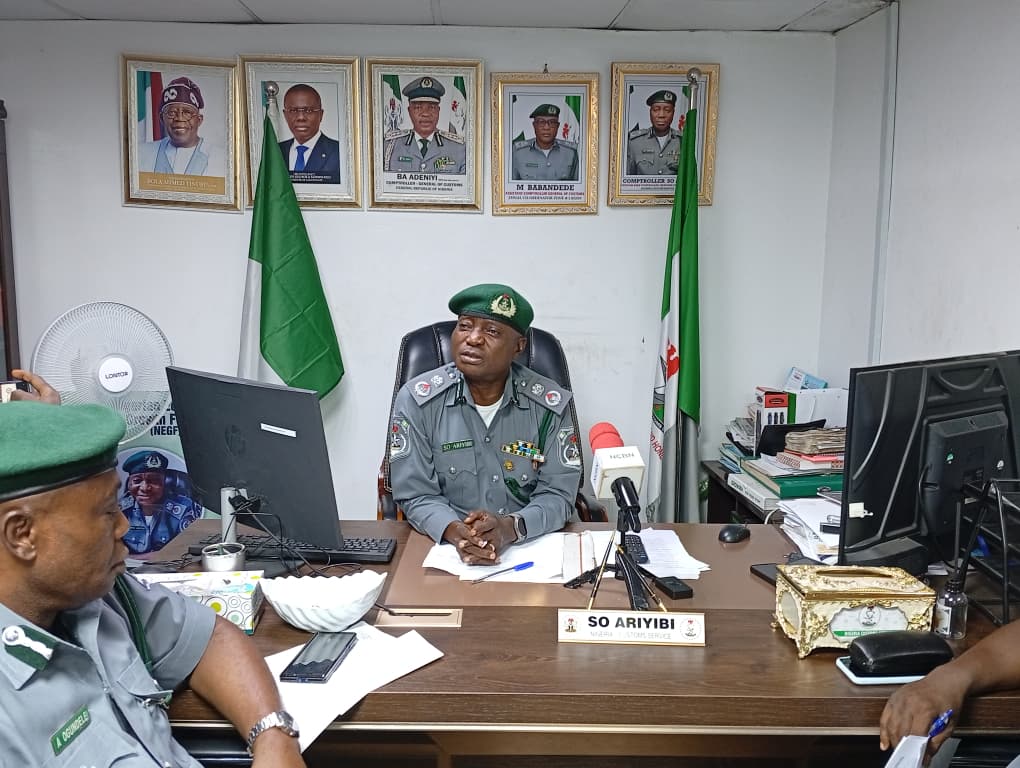
Customs Area Controller, Comptroller SO Ariyibi made this known on Thursday, 23 April 2026, dring a press briefing in Lagos, emphasising the critical role export trade plays in Nigeria’s economy.
Comptroller Ariyibi informed that the monthly performance within the quarter showed mixed trends when compared to the penultimate year 2025.
A breakdown of the record revealed that in January 2026, exports declined by 1.12%, amounting to $267.66 million compared to $270.70 million in January 2025; while February 2026 figure shows an increase of 12.43% from $225.13 million to $253.12 million in 2025.
Similarly, March 2026 witnessed a significant increase of 135.83%, with export value rising to $425.48 million from $171.76 million in March 2025.
According to the Controller, Container throughput equally recorded remarkable growth as the Command processed 19,014 export containers in Q1 2026, representing an increase of 9,292 containers or 95.58% over the 9,722 containers handled in the corresponding period of 2025.
He said export promotes foreign exchange earnings, drives economic diversification, and contributes significantly to Gross Domestic Product (GDP) growth. “While crude oil remains dominant, non-oil exports comprising agricultural produce, solid minerals, and manufactured goods are vital for mitigating external shocks, creating employment, and stabilising the national currency, the Naira,” he stated.
On Agricultural Produce:
He said, agricultural exports increased from $523.26 million in Q1 2025 to $608.46 million in Q1 2026, indicating a growth of $85.20 million, which reflects a steady and encouraging growth trajectory.
Manufactured Goods:
Related Posts
Export value rose significantly from $93.48 million in Q1 2025 to $297.36 million in Q1 2026, representing an increase of $203.88 million (Two Hundred and Three Million, Eight Hundred and Eighty Thousand USD). This underscores the sector’s emergence as a key driver of economic diversification.
Solid and Extractive Minerals:
Export value declined from $42.17 million in Q1 2025 to $5.23 million in Q1 2026, representing a decrease of $36.93 million. This according to Comptroller Ariyibi reflects a strategic shift towards local processing and value addition in line with government policy.
Export surcharge collections (2.5%) increased to ₦199.36 million (One Hundred and Ninety-Nine Million, Three Hundred and Sixty Thousand Naira) in Q1 2026, compared to ₦163.66 million (One Hundred and Sixty-Three Million, Six Hundred and Sixty Thousand Naira) in Q1 2025, representing a 21.81% increase.
Proceeds under the Nigeria Export Supervision Scheme (NESS) increased during the period. NESS collections rose by N1.01 billion, or 20.15 per cent, from N5.01 billion in Q1 2025 to N6.03 billion in Q1 2026.

The Controller noted that since taking over leadership of the Command, and in line with the policy thrust of the Comptroller-General of Customs, Bashir Adewale Adeniyi, he has consistently engaged in strategic consultations and engagements with relevant stakeholders.
He also informed that the Command has continued to implement measures aimed at enhancing export trade facilitation within its jurisdiction.
“The Command is actively advancing the deployment of the National Single Window platform, with Officers being adequately prepared for seamless implementation of a unified export documentation system in due course,” he noted.
He further urged all exporters operating within his area responsibility to remain compliant with extant export regulations, avoid all forms of infractions, and keep abreast of guidelines issued by the Federal Government.
The Controller concluded reaffirming the Command’s commitment to continuous stakeholder engagement, capacity building, and provision of necessary support to facilitate legitimate export trade, as part of efforts to strengthen the national economy through a favourable balance of trade.