

DC Maiwada Outlines Customs Strategies for Managing Nigeria’s Vast Land Borders
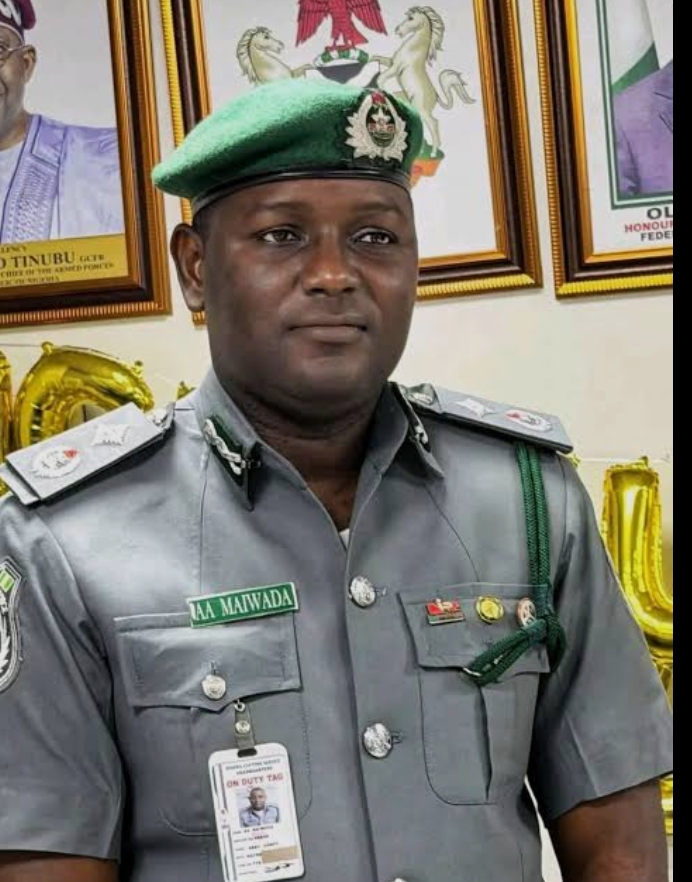
.Says Border Communities will Receive Consideration in Recruitment Exercise
.Announces Expansion of Geospatial Technology to improve border surveillance and management.
The Nigeria Customs Service under the leadership of the Comptroller -General of Customs, Adewale Adeniyi, is leveraging intelligence-driven operations, technology and community engagement as part of its integrated border management strategy to effectively secure and manage the nation’s over 4,000 kilometres of land borders despite operational challenges.
National Public Relations Officer of the NCS, Deputy Comptroller of Customs Abdullahi Maiwada stated this on Friday while featuring alongside other security experts on the Nigerian Television Authority (NTA)’s programme, Good Morning Nigeria, where he highlighted the Agency’s efforts to strengthen border security and reinforce effective border management.
Responding to concerns over the practicality of policing Nigeria’s expansive land borders, Maiwada described the country’s borders as difficult terrains with varying security dynamics across the geopolitical zones.
“Our borders are vast, rugged, difficult areas across geo-political zones and each area within the geopolitical zones has its peculiarity. How we perform anti-smuggling strategy in North East is quite different from that of the North West. Likewise, what happens in the South West also is based on their peculiarity,” he said.
“It is a very difficult area, however, the reality on ground is that no government agency is boastful of saying we have all we need to perform our function but yet what makes you a better organisation is the ability to use the minimum resources to achieve maximum results”.
According to him, the Service has also adopted strategic approaches that prioritises intelligence and technology.
“In terms of enforcement measures, we need to deploy strategic intelligence driven operations, you can’t be everywhere at a time,” he said.
Maiwada disclosed that the Service is expanding the use of geospatial technology to improve border surveillance and management.
“As I’m talking to you yesterday, the head of geospatial Unit of the NCS is in Seme border to establish partnership between NCS and Beninese Customs to see how the two countries can geo locate their borders and effectively manage the inflow and outflow of goods in and out of Nigeria.
“We have already geo locate all our locations in South Western Nigeria and we are going to move towards each part of the zone. With application of this type of tech solutions, we will spot the movement of inflow and outflow of goods.”
He also highlighted the success of intelligence-led operations such as Operation Whirlwind, a tactical team established to curb the smuggling of petroleum products.
“Last two years, we realised there is a kind of outflow of petroleum products out of Nigeria and we had a test from Operation Whirlwind and the strategy we have followed shows we have seen results from it. It is an intelligence driven operation, you will not see a vehicle written on it ‘Operation Whirlwind’ but because it is intelligence driven, the result is enormous,” he said.
Related Posts
The Customs spokesperson stressed that effective border management goes beyond enforcement and requires the support of border communities.
“It is not all about enforcement, it is also about those border communities, their understanding of why we are performing the functions. If I go for a raid or a patrol operations, and the community members hoard smugglers or are not helping out with necessary information for me to perform my function, definitely I will not succeed”.
He equally informed that the Service introduced the Customs Cares initiative to strengthen relations with host communities and demonstrate that its activities are aimed at promoting national development.
“So we have Enforcement, Cohesion and Persuasion is also important in managing the complex borders we have within Nigeria,” DC Maiwada asserted.
Speaking on the recently launched INTERPOL intelligence gathering capacity by the Comptroller-General of Customs, Maiwada said modern border management requires strong partnerships and interoperability among customs administrations and other security agencies.
“If you want to understand the dynamics of global supply chain, you also need to see how you can kind of orchestrate Customs to Customs operations, Customs to other government agencies operations, customs to business cooperation by having interlink, data base handshake with other enforcement agencies whom you share data and work such that there will be interoperability with what we do and what they do.”
He noted that several high-profile interceptions, including the recovery of stolen vehicles from Canada and seizures of illicit drugs and endangered species, were made possible through intelligence sharing with local and international partners.
“INTERPOL is also part of it, it is a way to consolidate, improve in what we are doing and is to make sure that we work together because no agency of government can work in isolation. We need to fight common enemy which is crime,” he said.
On concerns raised by border communities over recruitment into the Service, Maiwada said the current recruitment exercise remains ongoing and that the Comptroller-General had assured border communities that they would receive consideration.
“We are still on the recruitment process, we are yet to arrive at the final stage and they will be considered. Even though the slots are not much as expected. They will be considered to some certain extent,” he said.
The Customs Image maker also emphasised the importance of collaboration among security agencies, saying effective border management requires synergy among Customs, the Police, the Department of State Services, Immigration and other stakeholders.
“Nationally, the body language of the CGC is for us to collaborate. Right from NSA security members level, his mantra is working together as a team,” Maiwada stated.
He further cited the Service’s Memoranda of Understanding with the National Drug Law Enforcement Agency (NDLEA) and the National Agency for Food and Drug Administration and Control (NAFDAC) as examples of institutional collaboration aimed at ensuring transparency, proper prosecution of offenders and effective disposal of seized items.
According to the Service Spokesman, Area Controllers across various commands have also been directed to maintain strong working relationships with other security agencies to tackle cross-border crimes and facilitate legitimate trade.